
Labour Protection and Income Growth: General Collective Agreement Signed in Uzbekistan
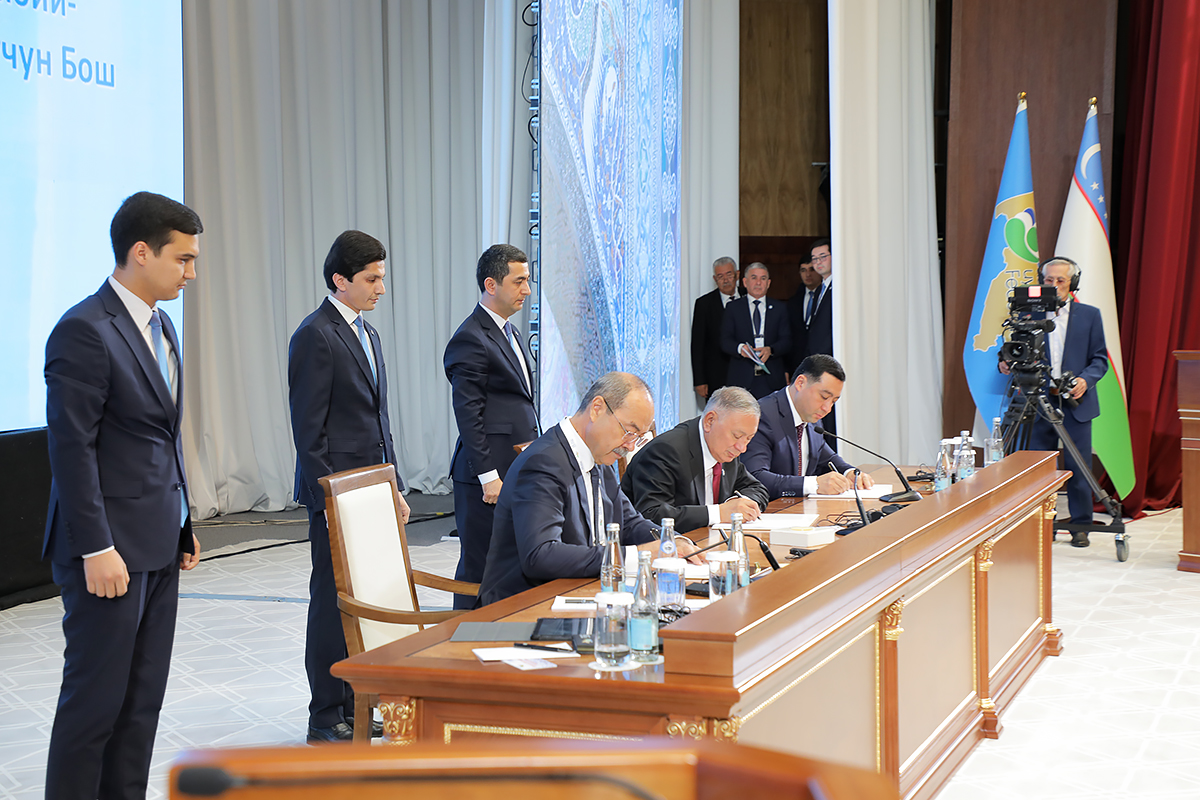
The General Collective Agreement between the Cabinet of Ministers of the Republic of Uzbekistan, the Federation of Trade Unions of Uzbekistan and the Confederation of Employers of Uzbekistan has defined the main areas of cooperation between the parties on socio‑economic issues for the years 2026-2028. The document was signed on November 1, 2025 within the framework of the IX Kurultay of the Federation of Trade Unions of Uzbekistan.
The agreement takes into account the opinions, suggestions and instructions voiced by the participants of the meeting of the President of the Republic of Uzbekistan Shavkat Mirziyoyev with trade union activists and veterans on October 17, 2025. During the dialogue, there were outlined priority tasks: to ensure the protection of workers’ rights in the context of the spread of remote and platform employment, to expand the participation of women in the economic life of the country, to strengthen the role of trade unions in the pre-trial settlement of labour disputes, and to accelerate the adoption of the Law “On State Social Insurance”.
In the field of economic development, the agreement establishes a number of strategic goals. It is planned to raise per capita income to 4 thousand US dollars within five years, which will create the prerequisites for the country’s transition to the category of countries with above-average incomes. The agreement provides for an increase in the share of technological products in industry to 32% and an increase in value added in the industrial sector to 45 billion US dollars. It is planned to create 2.5 million highly profitable jobs. Special attention is paid to the introduction of “green economy” technologies and a twofold increase in the energy efficiency of the national economy.
In terms of labour relations, the document introduces important mechanisms of interaction. The Republican Tripartite Commission will participate in the development of norms on the minimum wage. It is assumed that the rights of employees of the platform economy are protected, including labour protection and insurance issues. A unified accident accounting system will be created to prevent occupational injuries.
The social protection system will be further developed. It is planned to expand insurance coverage, provide financial support to low-income families, families with children, pensioners, war and labour veterans, and build sanatoriums and children’s camps. Social facilities such as kindergartens, gyms, and child care services will be created for families with children in special economic and industrial zones. A separate section is devoted to supporting youth and women. It is planned to develop dual education and expand programs to support women’s entrepreneurship, especially in rural areas.
Most of the provisions of the agreement will be implemented through sectoral and territorial collective agreements, as well as collective contracts. The parties undertook to summarize the results of the fulfillment of obligations at least once a year. The document strengthens the system of social partnership and serves as an important tool for the implementation of the “Uzbekistan‑2030” Strategy.
GCTU News
-
GCTU Discusses Amendments to Confederation’s Charter
On September 15, Moscow hosted a meeting of the Working Group on Preparing Amendments and Additions to the Charter of the General Confederation of Trade Unions (GCTU) at the Trade Unions Palace of Labor. Participants reviewed proposals from member organizations regarding necessary changes to the Confederation’s founding document.
-
Wage Standards in the CIS Must Reach a New Level
On September 10, the General Confederation of Trade Unions (GCTU) launched the development of a unified methodology for calculating the minimum consumer budget. The first meeting of the GCTU Executive Committee’s temporary working group on this initiative took place in Moscow.
-
A Unified Registry of Collective Agreements Should Be Established in the CIS
A unified registry of collective agreements in the Commonwealth of Independent States (CIS) will enable the regulation of labor relations at a cross-border level, according to the General Confederation of Trade Unions. The proposal by GCTU to include the creation of such a registry in the draft Plan of Activities for the Year of Social Development and Quality of Life in the CIS was approved by participants of the working group of the Advisory Council on Labor, Employment, and Social Protection of the Population of the CIS Member States. The working group meeting took place today at the CIS Executive Committee in Minsk, using video conferencing.